How to Read Pet Food Labels
What you feed your pet is important. It will likely be the single most impactful health decision you make for your pet. However, it can be difficult to evaluate what’s on the label unless you know what to look for!
Crunched for time? Get a quick list of pet food recommendations from a vet nutritionist! Check out my FREE eBook Best Foods for Your Dog. This free eBook provides expert guidance on choosing the best food for your dog. It includes essential tips for feeding and transitioning, along with 20 recommended food options for adult dogs and puppies alike!
We have also curated a PREMIUM version of this same eBook that includes:
- More detailed information about each company
- A Cost Comparison Chart that gives you a better idea of which foods give you the most bang for your buck!
If you are ready to finally understand this pet food label business once and for all, then read on….
When reading a pet food label use this simple acronym: “S.E.E” to remember these 3 steps.
Search: Search the ingredient list and check that meat is the predominant ingredient. If you can’t easily find the ingredient list, move on from this product. Check to see that all ingredients are from recognizable sources and that meat is the first ingredient. Supplements (vitamins & minerals) should not dominate the label.
Evaluate: Evaluate the Guaranteed Analysis section and check to see that the protein content exceeds the carb content. This is a somewhat complex process that involves some calculating which I will outline below.
Ensure: Ensure that the AAFCO statement on the packaging meets your pet’s needs.
Below is a Deeper Dive Into Each of the Steps of S.E.E.
Search
- Search for the ingredient list. If you cannot find it or it is not easily accessible (i.e. the company hides the ingredient list behind a customer login/questionnaire where they ultimately want your email), then move on to another food. This does not always indicate poor quality food; it instead could indicate you may be dealing with a company that prioritizes sales over transparency (a concerning yellow if not red flag).
- Next, check to see that the primary ingredient is meat (protein). This is sometimes not as simple as checking the first ingredient on the packaging. Pet food companies will often manipulate ingredient labels in an effort to make meat appear as high on the list as possible while keeping their actual use of it in their food very low. The challenge is that they must list the ingredients they use by weight.
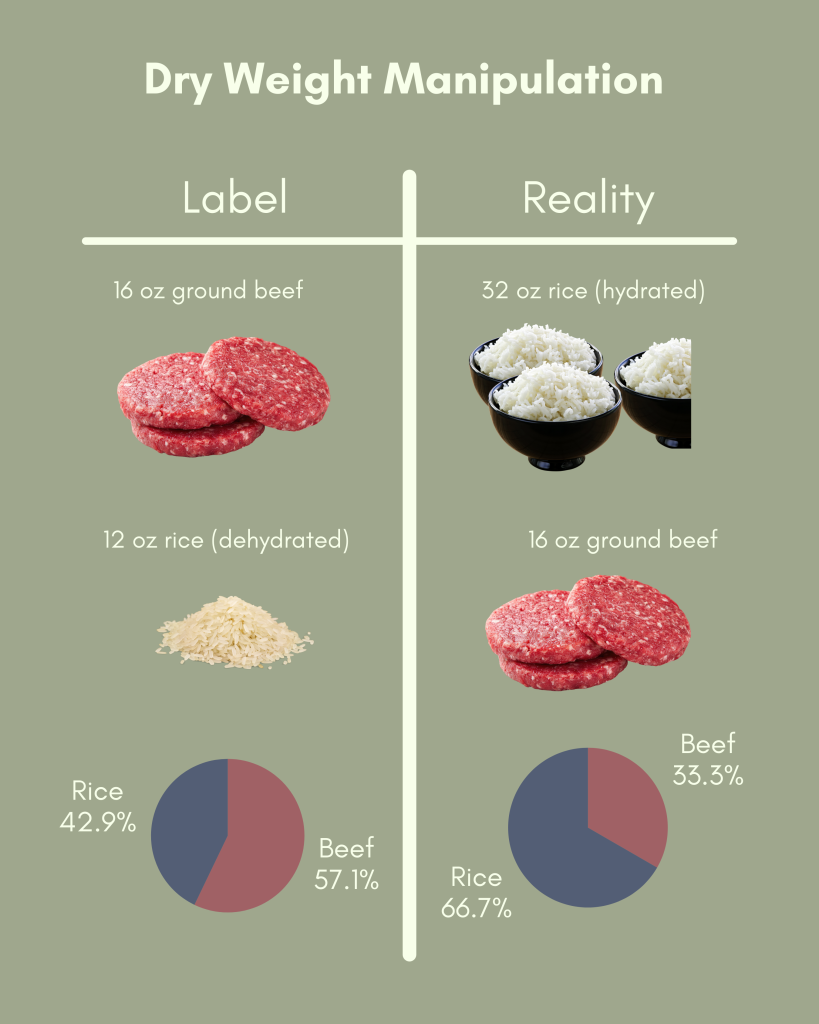
Dry Weight Manipulation is when an ingredient (like rice) is listed in its dry, uncooked form on a label. Rice should be measured and weighed in its wet form, after cooking. When it’s measured before, it will make it appear as if the carbohydrate content is lower than is actually present. As shown under the “Reality” section of Image 1, the rice (when RE-hydrated) makes up the majority of the weight in the food (66%).
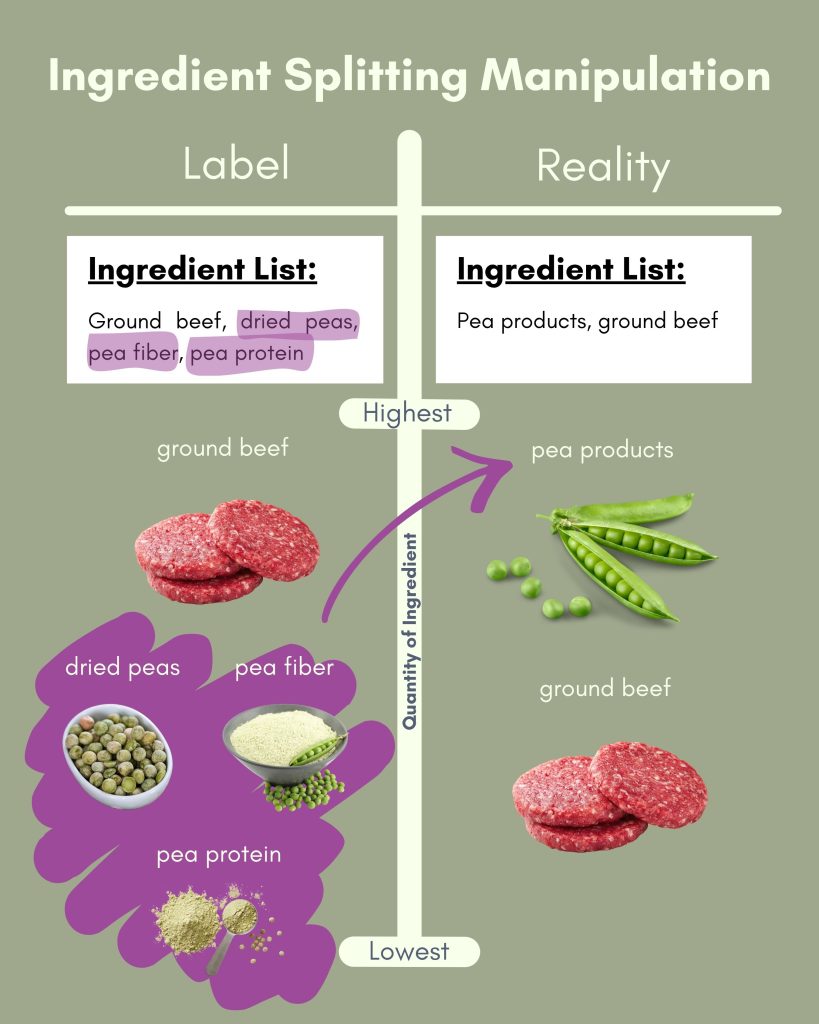
- Make sure all or most ingredients are whole foods and that the protein sources are specified. Avoid foods with ingredients that provide no nutritional value like: “food coloring” and “natural flavor”. Also keep an eye out for waste products from the human food industry like: pulps, pomace and nut shell hulls. A good pet food company will be specific and will list their meat sources. Avoid labels that use nonspecific terminology to describe their meats like “meat meals” and “meat by-product meals”. This goes for plant-based ingredients as well, avoid: “corn gluten meal”, “wheat middlings” and “corn germ meal”.
- A large block of listed supplements is often the most obvious red flag. This often indicates that the food lacks vital nutrients due to over processing and heating. Though, you may still find some supplements in a good food. For instance, all cat foods will list taurine. Taurine is an amino acid vital to heart health. It is difficult to ensure taurine levels due to multiple factors but essentially it is simpler and cheaper to add taurine artificially than to test the taurine levels in specific formulations. If there are more than 5 supplements listed, the food itself is likely not as nutritious as they claim.
Evaluate
Once you’ve located the Guaranteed Analysis, we can calculate the protein to carbohydrate ratio by using the percentages listed here.
- A species appropriate diet for dogs will have a protein percentage between 40-65% DM and a carbohydrate percentage between 10-30% DM.
- A species appropriate diet for cats will have a protein percentage between 50-65% DM and a carbohydrate percentage between 5-10% DM.
Steps:
- Calculate Carbs: To accurately compare the protein and carbohydrate percentages of a food, you first need to calculate the carbohydrate percentage.
- Note: Carbohydrate percentage is not currently a required value that companies need to list. However, AAFCO will begin requiring carbohydrate percentages listed come 2029. Calculating carbohydrates is simple:
- First add together the protein + fat + ash (minerals) + moisture percentages.
- (Ash is the mineral residue that remains after the food burns during nutritional lab testing.) It typically makes up about 3% of the total recipe, so use a 3% estimate in your calculations if the label does not list it.
- You do not need to include fiber in the calculations because it is part of the total carbohydrate content.
- Then subtract the sum from 100: (100 – [sum of percentages]% )
- This will give you the total percentage of carbohydrates when the food is at its intended consumable moisture content.
- First add together the protein + fat + ash (minerals) + moisture percentages.
- Note: Carbohydrate percentage is not currently a required value that companies need to list. However, AAFCO will begin requiring carbohydrate percentages listed come 2029. Calculating carbohydrates is simple:
- Calculate DM: Moisture content can be very misleading as we learned in the “Dry Weight Manipulation”. Before you can evaluate two foods, you need to convert everything to a Dry Matter Basis or “DM” for short. To convert everything to a “Dry Matter Basis”, you need to subtract the water:
- First, note what percentage of the diet is moisture.
- Then subtract the moisture from 100. Whatever remains is the food devoid of water (DM).
- Calculate Protein DM: Divide your protein percentage by the DM value. This will give you the true protein content.
- Calculate Carb DM: Next divide your carbohydrate percentage by the DM value. This will give you the true carbohydrate content.
- Now that you know how to subtract the full moisture content of food, you can now compare two entirely different types of food (i.e. kibble vs. gently cooked).
Below I have provided an example. You’ll notice that depending on the type of food, the carbohydrate percentage can look wildly different – that is until you convert everything to a Dry Matter basis:
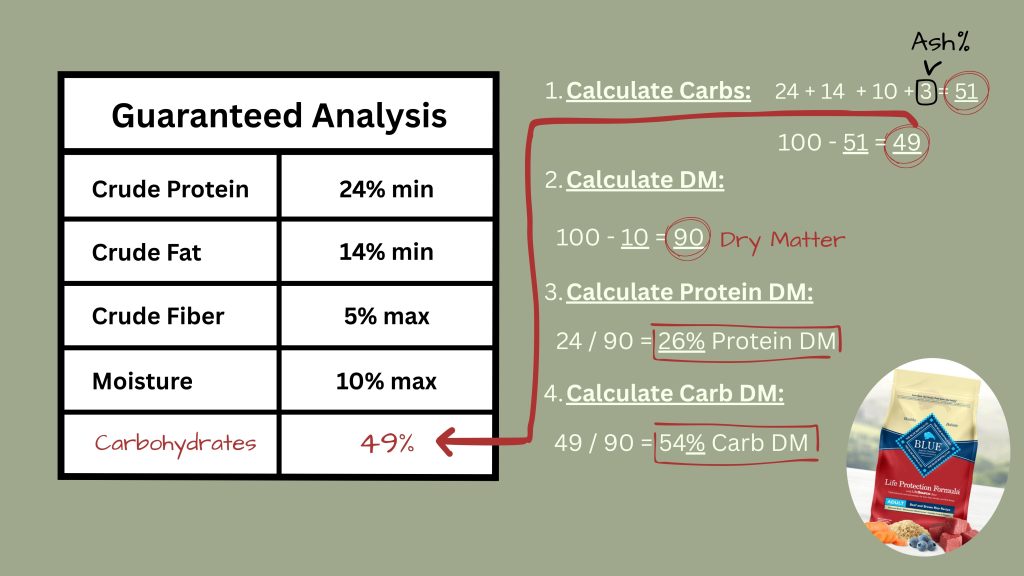

Recommended Species Appropriate Percentages for Dogs:
- Protein% DM: 40-65%
- Carbohydrate% DM: 10-30%
As you can see, neither of the foods evaluated above meet recommended species appropriate percentages of protein or carbohydrates for dogs. (The percentages shown in the Guaranteed Analyses above are accurate as of 4-17-2026 and are listed on their website.)
Ensure
- Ensure that the food you are considering suites your pet’s needs by reading the AAFCO nutritional statement. This statement can sometimes be difficult to find, but every pet food diet on the market should have this designation. Usually you can find the statement underneath the guaranteed analysis under the ingredient list or at the very bottom of the packaging (it is almost always in very small print). There are four possible statements that you will come across, but there are only two that most pet owners really need to focus on. Statements are verbatim:
- [Diet X] is formulated to meet the nutritional levels established by the AAFCO [Dog/Cat] Food Nutrient Profiles for [adult maintenance/All Life Stages/growth/lactation/gestation].
- If the statement says for “growth” or “All Life Stages”, then the statement must also state one of these two phrases depending on calcium content: “Including the growth of large breed dogs (70lbs or more as an adult)”, or “Except for growth of large breed dogs (70lbs or more as an adult)”
- This product is intended for intermittent or supplemental feeding only.
- [Diet X] is formulated to meet the nutritional levels established by the AAFCO [Dog/Cat] Food Nutrient Profiles for [adult maintenance/All Life Stages/growth/lactation/gestation].
- Nutritionally complete and balanced pet food diets use the first statement and treats use the second.